A small record the search keeps for each state it reaches: the state, its parent (the node it came from), the action that got here, and the path cost so far.
Key idea
At the goal, follow the parents back: Salisbury → Stockbridge → Winchester. Reverse the actions and you have the solution.
The frontier: a to-do list of nodes
frontier = a node with the initial state
explored = an empty setrepeat:if the frontier is empty: there is no solution
remove a node from the frontier
if the node is a goal: return the solution
add the node to explored
expand the node: add each neighbour to the frontier
unless it is already in the frontier or explored
Frontier: the nodes we have found but not looked at yet.
Expand: use ACTIONS and RESULT to find the neighbours of a node.
Roads go both ways: Winchester → Stockbridge → Winchester → … What could go wrong?
The search could go round in circles forever.
Explored set: the states already looked at. Never add them to the frontier again.
Which node comes out next?
The frontier holds three nodes, added in the order A, B, C. Which one should the search take out next?
Stack
Last in, first out. Like a pile of plates: you take the top one.
DFS depth-first search
Queue
First in, first out. Like a queue at a café: first come, first served.
BFS breadth-first search
Key idea
This one choice is the only difference between depth-first and breadth-first search. The rest of the loop is the same.
Depth-first search STACK
waiting in the frontierexplored (in order)path
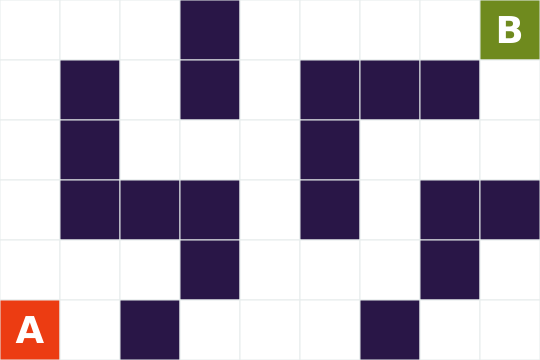
Rule: always take the newest square in the frontier. The frontier is a stack.
Step 2. A has two open neighbours. The right one went in last, so DFS goes right.
Step 5. Dead end. DFS takes the square that has waited above A since step 1.
Step 16. Another fork. Again it takes the newest square, and heads down.
Step 25. B, after exploring 25 squares. Three squares were never looked at.
DFS found a 21-step path. In Week 1 you found a shorter one. How long was it?
17 steps. DFS stops at the first path it finds, and that may not be the shortest.
Breadth-first search QUEUE
waiting in the frontierexplored (in order)path
Rule: always take the oldest square in the frontier. The frontier is a queue.
Steps 2–3. One step up, then one step right. BFS tries every direction before it goes further.
Steps 16–28. At the fork it takes turns: one step on the top route, one on the lower route, and so on, like a ripple spreading out.
Step 29. B, after exploring 29 squares: more than DFS.
But its path is 17 steps, the shortest, the same as your Week 1 answer.
So which search is better?
Neither always wins. BFS always finds the shortest path, when every step costs the same. DFS can be quicker, but its path may be long.
Trace it: DFS and BFS
Start at A, the goal is D. In what order does each search take nodes out of the frontier? Pairs · 3 min
DFS take the last one added (stack)
Step
Take out
Frontier after
1
A
B C
2
C
B F
3
F
B
4
B
D E
5
E
D
6
D
goal ✓
BFS take the first one added (queue)
Step
Take out
Frontier after
1
A
B C
2
B
C D E
3
C
D E F
4
D
goal ✓
Children join the right-hand end of the frontier, left child first.
Both return A → B → D. BFS took out 4 nodes; DFS took out 6, because it went down C first.
Run maze.py, switch StackFrontier to QueueFrontier, and compare maze2.txt and maze3.txt.
A game as a search problem
In a maze, nobody fights back. What changes when there is an opponent?
The opponent chooses every other move, and wants the opposite result to you.
X to move. Where should X play?
S0
the initial state: an empty board
PLAYER(s)
whose turn it is: X or O
ACTIONS(s)
the empty squares
RESULT(s, a)
the board after playing in square a
TERMINAL(s)
is the game over? (a win or a full board)
UTILITY(s)
the score of a finished game: X wins +1, draw 0, O wins −1
MAX X wants the score as high as possible. MIN O wants it as low as possible.
Minimax on a real game
X to move on the board from the last slide. Which square should X take? Let minimax decide.
1. Score each finished game: X wins +1, draw 0, O wins −1.
2. Under each of X’s moves, O (MIN) replies with its lowest score.
3. X (MAX) takes the highest: block top-left, a draw (0). Top-middle looked tempting, but O wins first.
Minimax
The same kind of tree as the tic-tac-toe slide, with numbers in place of boards. Each line is a move. The bottom numbers are the scores of finished games, like +1, 0 and −1 but with more values: higher is better for you, lower is better for your opponent.
You are MAX. MIN always replies with the lowest score it can. Which move should you make?
Work from the bottom up. Each MIN node takes its lowest child: 4, 3, 2.
MAX takes the highest of those: the left move, worth 4.
The middle has a 9, but MIN will never let you get it.
Minimax in pseudocode
functionMAX-VALUE(state):
ifTERMINAL(state): returnUTILITY(state)
v = −∞
for action inACTIONS(state):
v = MAX(v, MIN-VALUE(RESULT(state, action)))
return v
functionMIN-VALUE(state):
ifTERMINAL(state): returnUTILITY(state)
v = +∞
for action inACTIONS(state):
v = MIN(v, MAX-VALUE(RESULT(state, action)))
return v
To choose a move
MAX picks the move with the highestMIN-VALUE. MIN picks the move with the lowestMAX-VALUE. The two functions call each other, all the way to the end of the game.
Pseudocode is a program written in plain words. It is not a real language and does not run. The top block, line by line:
function MAX-VALUE(state): takes a state and returns a score. The indented lines belong to it, as in Python.
if TERMINAL(state): is the game over? Then the value is just its score.
v = −∞ start below any real score, so the first real score replaces it.
for action in ACTIONS(state): try each legal move in turn.
v = MAX(v, MIN-VALUE(…)) score the move by asking what MIN would do next, and keep the best score so far.
The bottom block is the same for MIN: start at +∞ and keep the lowest.
Alpha-beta pruning: skip what cannot matter
Each line is a move. The bottom numbers are the scores of finished games, like tic-tac-toe’s +1, 0 and −1 but with more values: higher is better for you, lower is better for your opponent.
You already have a move worth 4. In the middle, MIN can reach 3. Do you need to look at the 7?
No. MIN will pick 3 or less here, so this move is worth at most 3 to you. You already have 4. Stop looking.
On the right, the first leaf is 2. Same story: skip the rest.
Same answer as minimax, but 3 of the 9 leaves were never looked at.
Too big to search to the end
255,168possible games of tic-tac-toe
1029000possible games of chess (roughly)
A computer can play out every game of tic-tac-toe in a moment. Could it do the same for chess?
Depth-limited minimax
Look only a fixed number of moves ahead, then stop, even though the game is not over.
Evaluation function
Estimates how good a position is without playing to the end. For example, in chess: count the pieces each side has left. The program is only as good as this estimate.
Search in the real world
Sat-navs and map apps: road junctions are states, roads are actions.
Game engines: chess and Go programs use adversarial search.
Warehouse robots: plan paths that avoid shelves and other robots.
Video games: characters find their way round the map.
Puzzles: Rubik’s cube and sliding-tile solvers.
Discuss
A sat-nav app picks the “best” route for millions of drivers. Best for whom: fastest, shortest or least fuel? Who gains and who loses? Groups · 10 min
The path cost is a design decision. It changes where traffic goes.
Thank you
Practical: week02-search/maze in the module code
Next week: smarter search with heuristics (greedy best-first and A*), then logic
Reading: Russell & Norvig, sections 3.1–3.4 and 5.1–5.3; Poole & Mackworth, sections 3.1–3.5 and 14.3
Sakib.Anwar@winchester.ac.uk
Adapted from CS50’s Introduction to Artificial Intelligence with Python by Brian Yu and David J. Malan, Harvard University, licensed under CC BY-NC-SA 4.0.